Johannes Vermeer / c.1670–72
A room gathered inside a sphere
Why does a small hanging sphere matter more than its size suggests?
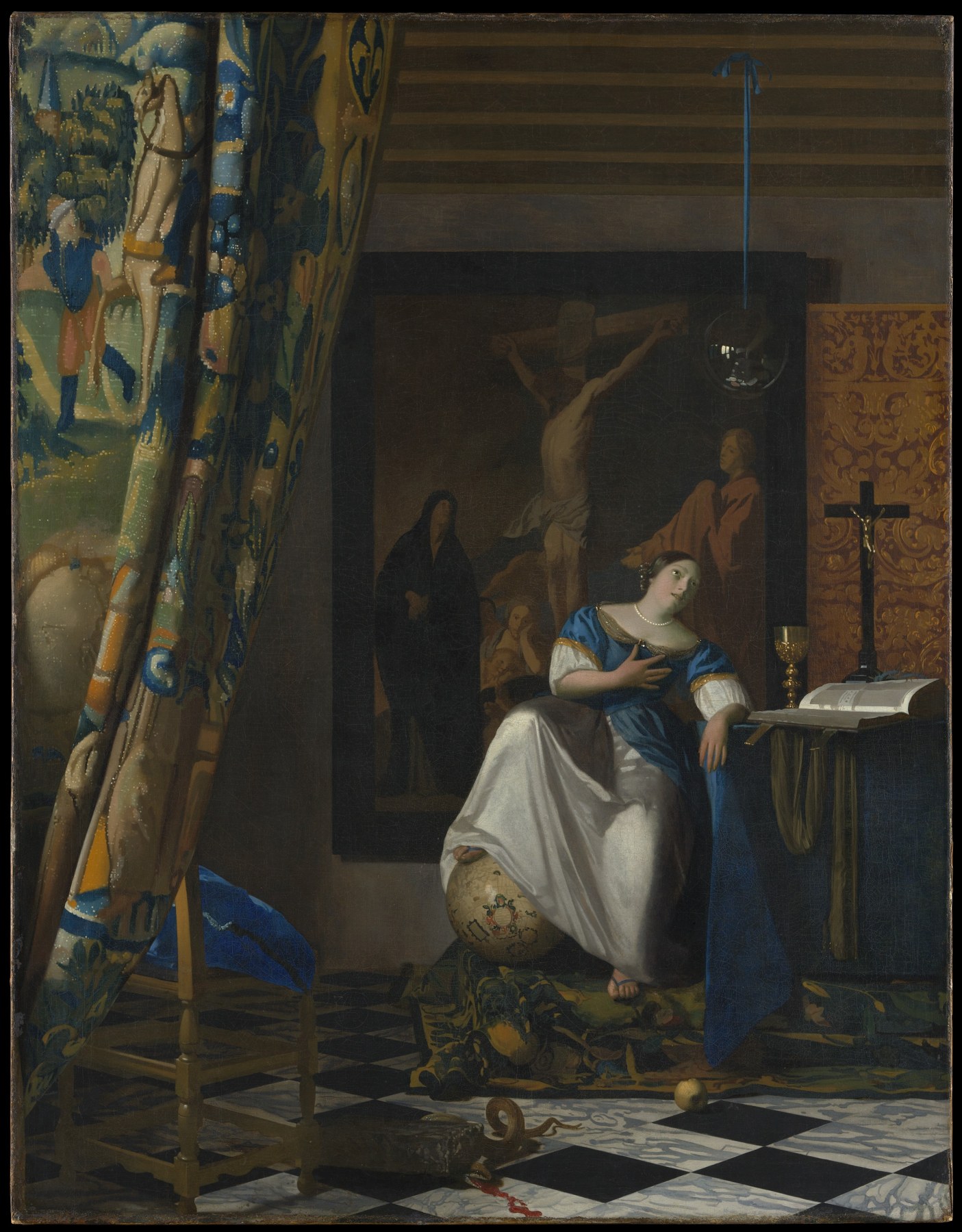
Johannes Vermeer, Allegory of the Catholic Faith, c.1670–72. Oil on canvas. The Metropolitan Museum of Art, New York.
Look first
The woman does not look at us. Her gaze rises towards the hanging glass sphere. Follow that direction before trying to name the other objects. The sphere occupies a small area, but a human gesture gives it importance.
The room feels staged. A tapestry has been drawn aside; a table carries ceremonial objects; a large painting fills much of the back wall. The floor contains things that would interrupt ordinary movement through a room.
Instead of treating every object as a clue in an undifferentiated code, separate what can be seen from what needs historical knowledge. You can follow a gaze immediately. Identifying an allegory requires another kind of evidence.
The detail
A glass sphere can gather a broad reflected view within a small surface. That visible possibility makes it an effective object for an idea about containing something much greater than oneself.
A question to take back to the picture
Can you follow the woman's gaze before noticing the sphere itself?
What we know
The Met reads the scene as an allegory of the Catholic Church in a Dutch setting where public celebration of the Mass was forbidden. Scholars connect the sphere to an emblem tradition in which a small reflective globe can contain a vast view. The exact route by which Vermeer encountered the idea is uncertain.
One way to read it
The painting gives an abstract claim the materials of a domestic room: fabric, glass, floor tiles and human weight. The room may suggest a private place of worship, but its exact commissioner and setting have not been securely identified. A symbolic interpretation is not a recovered statement by the painter.
Try it yourself
Make two lists. Put visible facts in one: the gaze, the cord, the round objects. Put historical readings in the other. Connect a reading to the feature that supports it. Leave any unsupported link as a question.
Sources, freely available
- The Met: work, context and curator discussion ↗
- National Gallery of Art: Vermeer exhibition catalogue ↗
Image credit and use
Johannes Vermeer, Allegory of the Catholic Faith, ca. 1670–72. The Friedsam Collection, Bequest of Michael Friedsam, 1931, 32.100.18. The Metropolitan Museum of Art. CC0. Faithful crop/scaling only; the whole photograph is unchanged. Exact source record. No museum endorsement is implied.