Paul Klee / 1925
A world revealed through darkness
Can taking paint away make a picture feel more full of possibility?
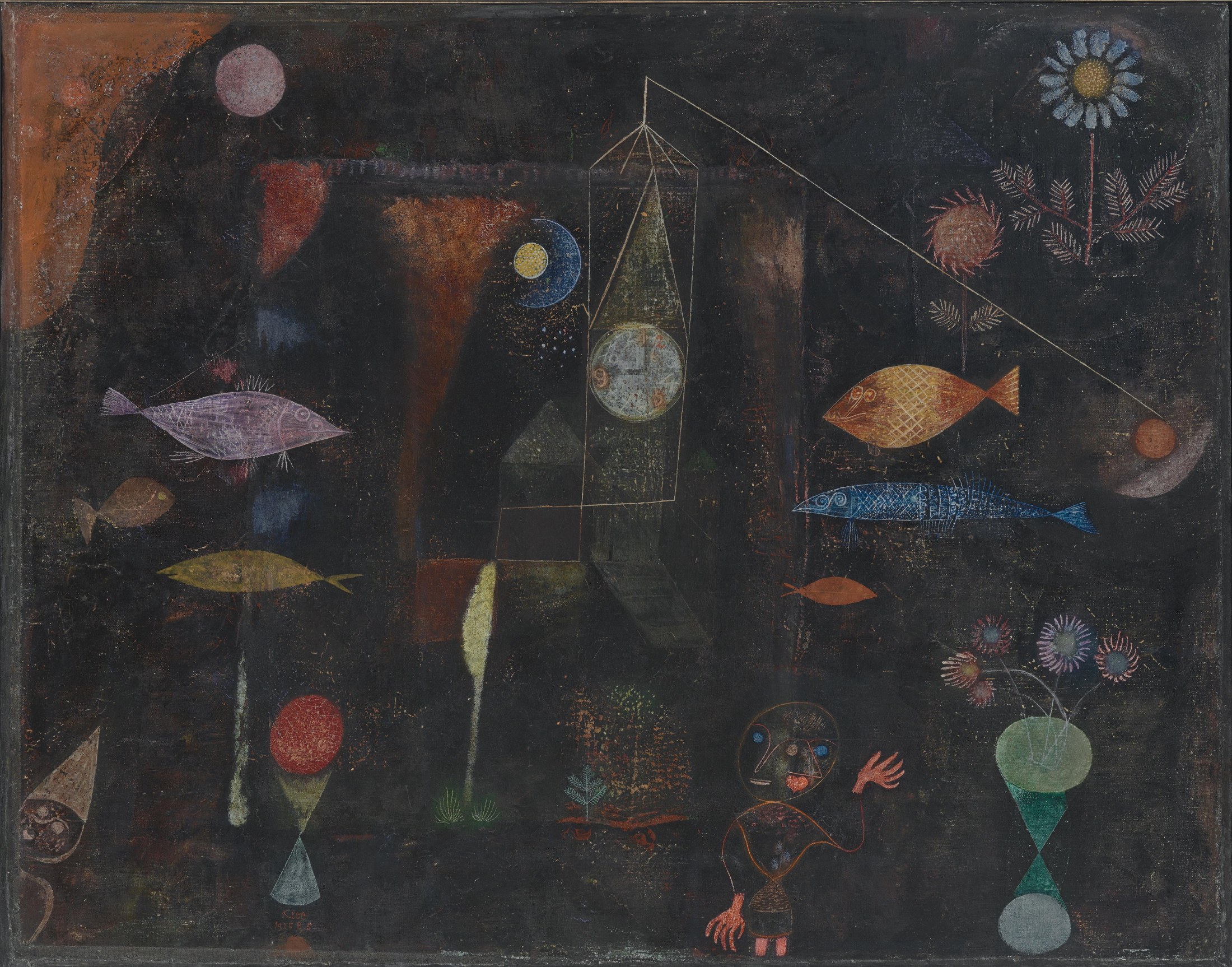
Paul Klee, Fish Magic, 1925. Oil and watercolour on canvas on panel. Philadelphia Museum of Art.
Look first
Name three recognisable forms. Then try to put them in a single physical setting. Fish, plant-like shapes and a clock resist that demand. The dark ground allows them to coexist without supplying the normal divisions between water, land and sky.
Look at the different sizes of the marks. Some colours stand out immediately; thin lines take longer to follow. The image has no moving parts, but it gives looking a sequence. A small change of attention can reorganise the whole.
You do not need a complete symbolic dictionary before starting. Recognition, comparison and uncertainty are already experiences the painting makes available.
The detail
The museum describes coloured layers under a black surface, revealed through scratching and scrawling. A bright mark can be a place where covering has been removed. Darkness is therefore an active part of the construction, rather than unused background.
A question to take back to the picture
Which forms could belong both underwater and in a night sky?
What we know
Klee made Fish Magic while teaching at the Bauhaus. His Pedagogical Sketchbook was published in 1925. Bauhaus teaching sources describe his interest in the development and relationships of forms. That context supports looking at construction; it does not supply a fixed translation of every fish or circle.
One way to read it
One possible reading connects the making process with the experience of discovery: colour becomes visible through black paint, and familiar things emerge from an uncertain setting. The technique makes that reading plausible without turning it into the painting's only authorised meaning.
Try it yourself
On scrap paper, draw five simple forms and connect two with a line. Give the line three possible jobs: an object boundary, a stem or a direction of movement. Return to Klee and find places where a similarly simple mark changes role.
Sources, freely available
Image credit and use
Paul Klee, Fish Magic, 1925. Philadelphia Museum of Art, The Louise and Walter Arensberg Collection, 1950, 1950-134-112. Public-domain reproduction via Wikimedia Commons. Faithful crop/scaling only; the whole photograph is unchanged. Exact source record. No museum endorsement is implied.
